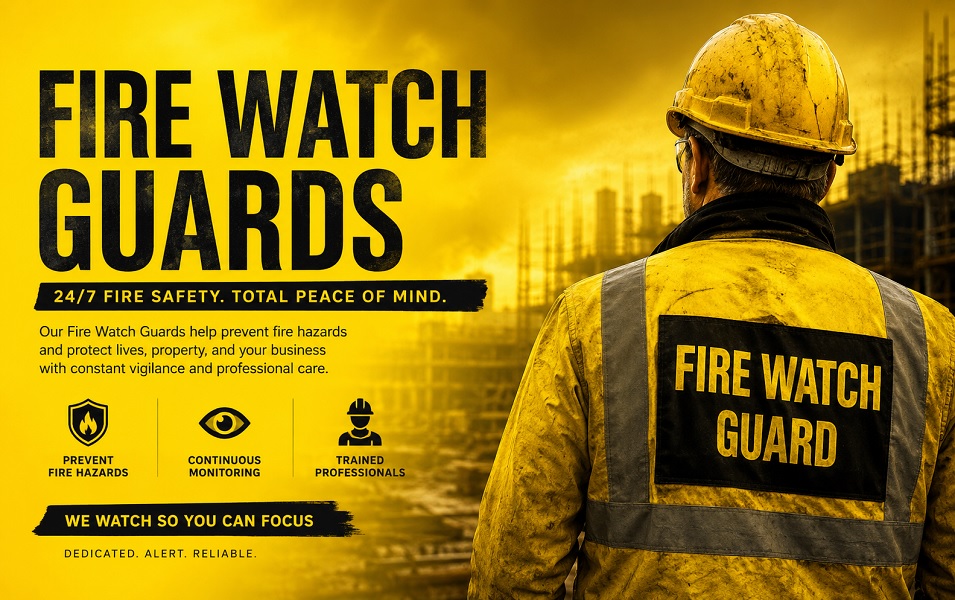
Fire Watch Guards vs Fire Risks: Who Wins Every Time?

The moment a fire suppression system goes offline, a building doesn’t just lose a safety feature — it loses its first line of defense. What stands between that vulnerability and potential catastrophe? Fire Watch Guards — trained professionals who become the human equivalent of every sensor, alarm, and sprinkler that just went dark.
Every year, commercial properties, construction sites, hospitals, and industrial facilities across the United States face windows of exposure that most owners don’t fully appreciate. A sprinkler system under maintenance. A fire alarm tripped offline during a renovation. A welding crew working through combustible materials. These aren’t edge cases. They’re routine operational realities — and routine is exactly where disasters hide.
The Invisible Threat No Sensor Can Catch
Modern fire protection technology is remarkable. But technology has blind spots. Sensors malfunction. Systems need upgrades. Code compliance requires temporary shutdowns. During these gaps — which NFPA regulations mandate must be covered immediately — the building is technically unprotected.
A fire watch guard steps into precisely that gap. Unlike passive detection equipment, these professionals use sight, smell, and sound to assess a space in real time. They move. They adapt. They make judgment calls. A sensor can’t smell an overheating electrical panel two rooms away. A trained human can.
This is where the human advantage becomes undeniable. Fire risks don’t always announce themselves through smoke columns and visible flames. They build slowly — through blocked emergency exits, leaking flammable materials, overloaded circuits, or improperly stored chemicals. A professional guard doing systematic patrols every 15 to 30 minutes catches these escalating conditions long before they become irreversible.
What Fire Watch Guards Actually Do on the Ground
Strip away the industry jargon and the role becomes elegantly clear: a fire watch guard is a mobile, responsive, intelligent safety system.
Their core responsibilities go far beyond simply walking a property. At every patrol, they’re documenting hazards, verifying that fire extinguishers are accessible and within certification dates, ensuring exit pathways are clear, and maintaining direct communication with both the site supervisor and local fire department. If fire breaks out, their first responsibility isn’t to fight it — it’s to trigger evacuation protocols and alert emergency responders immediately.
The paperwork matters as much as the patrol. Detailed fire watch logs — time-stamped, initialed, and annotated with hazard observations — aren’t bureaucratic busywork. Insurance companies review them. Fire marshals audit them. They become the documented proof that a property remained in a state of supervised compliance throughout a system outage. In litigation, that paper trail can be the difference between a covered loss and a catastrophic liability.
The Scenarios Where Human Vigilance Is Non-Negotiable
Certain industries operate at elevated fire risk as a baseline. Construction sites, petrochemical facilities, film production sets, large-scale event venues, hospitals undergoing infrastructure work — these environments combine dense human activity with combustible materials and complex mechanical systems.
Hot work is among the highest-risk scenarios any site faces. Welding, torching, soldering, and grinding generate sparks that can smolder inside wall cavities for hours before erupting into flame. No automated system monitors residual heat migration through a building’s structure after a crew packs up for the night. A fire watch guard does — staying on post for a minimum of 30 to 60 minutes after hot work concludes, per standard safety protocols.
Large events add a different dimension. Temporary structures, generators, crowded exits, and improvised electrical setups create a volatile combination. The presence of a dedicated fire watch professional at these events transforms what could be a reactive situation into a proactive one. Prevention doesn’t make headlines. The fires that never happen don’t trend on social media. But they represent the entire value proposition of this industry.
OSHA, NFPA, and the Compliance Framework Driving Demand
The regulatory environment around fire watch services has become increasingly structured — and increasingly enforced. OSHA standards and NFPA 101 (Life Safety Code) both establish clear requirements: when a fire protection system is impaired for more than four hours within a 24-hour period, a fire watch must be established immediately.
This isn’t optional guidance. Non-compliance exposes property owners to substantial fines, permit revocations, and in the event of a loss, potentially voided insurance coverage. The demand for professional fire watch guards has surged precisely because building owners understand that cutting corners on compliance during a system outage isn’t a cost-saving measure — it’s a liability creation exercise.
Licensed, insured, and certified fire watch companies operating across all 50 states now offer rapid-deployment models, with some providers promising on-site guard deployment within hours of an emergency call. That speed matters. A four-hour window can close fast.
The Economics of Prevention vs. Loss
Frame it in pure financial terms and the calculation becomes immediate. The average commercial fire loss in the United States runs into hundreds of thousands of dollars before factoring in business interruption, reputational damage, and potential legal exposure. Professional fire watch services, by contrast, are priced accessibly — varying by state, but typically ranging from $45 to $85 per hour for fully licensed personnel.
Stack those numbers side by side and the math is not subtle. A 48-hour fire watch deployment during a sprinkler system repair might cost a few thousand dollars. A single unmonitored fire incident could cost millions — and that’s before a single lawsuit is filed.
Risk managers at sophisticated organizations already understand this calculus. They treat fire watch services the same way they treat cyber insurance or environmental compliance audits: not as reactive necessities, but as proactive risk mitigation tools embedded in operational planning. The companies that haven’t updated this thinking yet are operating on borrowed time.
Training, Certification, and the Human Behind the Patrol
The effectiveness of any fire watch program rests entirely on the quality of the individual doing the watching. Reputable fire watch guard providers train their personnel in fire prevention, hazard identification, fire suppression basics, first aid, CPR, and emergency communication protocols. These aren’t security guards assigned to fire watch duty as an afterthought. The best providers — many founded by active and former firefighters and law enforcement veterans — build teams with domain expertise at their core.
That expertise shows in the details. A trained guard recognizes the smell of an overheating motor. They know that a propped fire door in a hospital wing violates code. They understand that a pile of oily rags in a maintenance closet isn’t just messy — it’s a spontaneous combustion risk. These micro-judgments, made dozens of times during a single shift, are what separate a professional fire watch operation from a warm body walking a floor.
Certification requirements vary by state, but the professional bar has been rising consistently as the industry matures and regulatory agencies increase their scrutiny. Clients selecting fire watch services should prioritize providers who are fully licensed, bonded, insured, and operating within their state’s specific security contractor regulations.
What the Future of Fire Watch Looks Like
Technology is beginning to layer into the fire watch model — but not in a way that replaces the human element. Integrated patrol management systems now allow guards to log check-ins digitally at designated waypoints, creating a real-time compliance record accessible to clients and supervisors simultaneously. Some providers are incorporating wearable sensors and mobile reporting platforms that give building owners live visibility into patrol activity.
This isn’t automation replacing vigilance. It’s technology amplifying it. The core function of fire watch guards — sustained human attention in high-risk environments — remains irreplaceable precisely because fire itself is unpredictable, dynamic, and indifferent to algorithms.
The buildings that never burn, the construction projects that finish without incident, the events that end without a single emergency — these outcomes don’t happen by accident. They happen because someone was paying attention. Someone was walking the floor at 2 a.m. Someone knew what to look for, what to document, and what to do when everything changed in an instant.
That someone is a fire watch guard. And in every matchup against fire risk, the answer to who wins is always the same: the side that showed up prepared.